
Breast Cancer in Women Under 40


Breast Cancer in Women Under 40: When Should You Get a Breast Check?
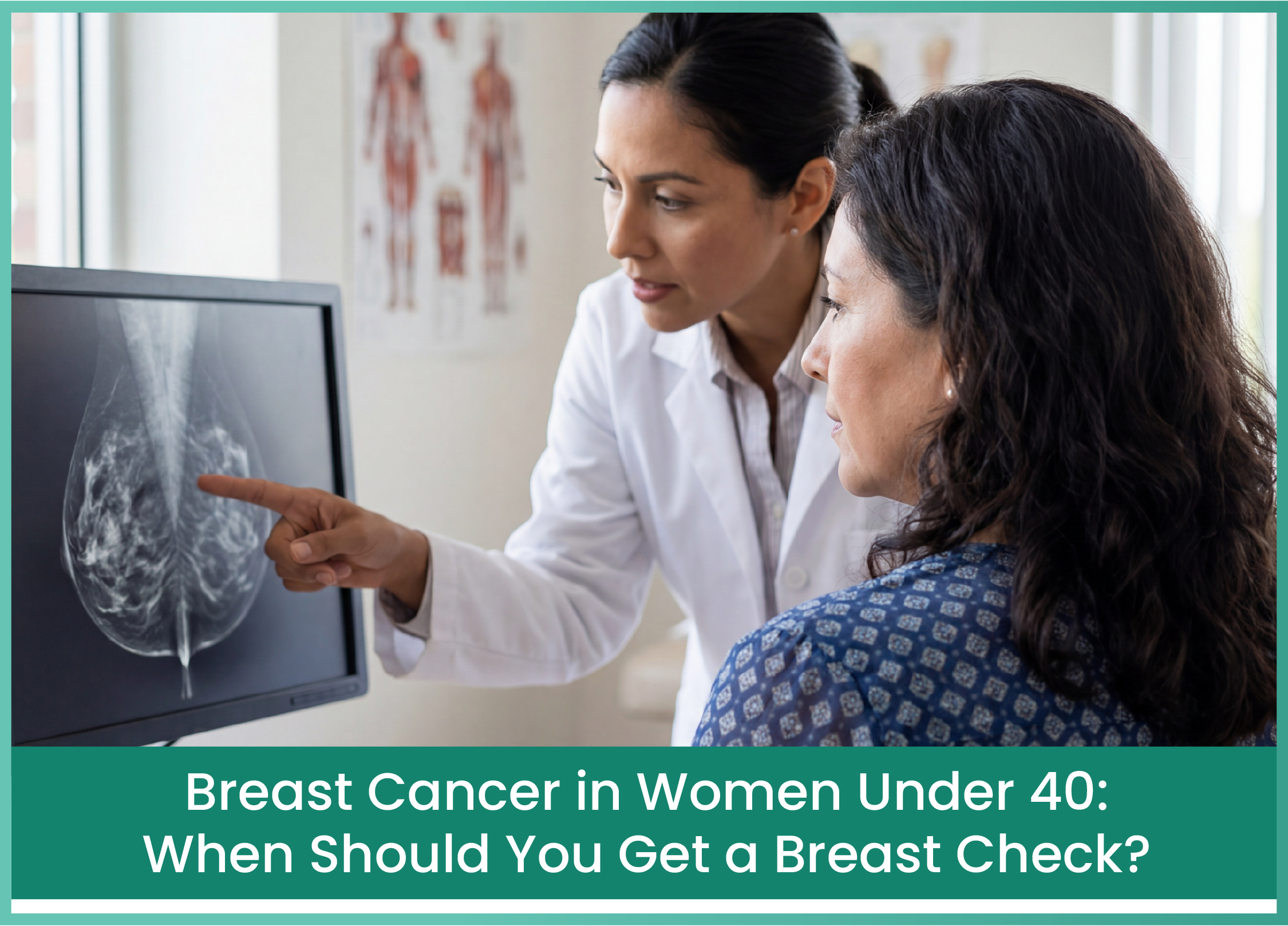
When you are in your 20s or 30s, breast cancer may feel like something that happens much later in life. A breast lump may be blamed on hormones, menstrual changes, stress, or a benign condition. And while many breast changes in younger women are not cancer, being young does not completely eliminate the possibility.
Breast cancer in women under 40 is less common than in older women, but it can still occur. The important thing is understanding when a breast change is likely to be temporary and when it deserves a proper medical evaluation.
One of the biggest misconceptions is that a woman should wait until 40 before worrying about her breast health. This is not correct. Routine screening and checking a new breast symptom are two different things.
A woman under 40 may not require routine mammography simply because of her age, but a new or persistent breast lump, nipple change, skin change or unusual swelling should not be ignored.
So, when should you get a breast check if you are under 40?
The answer depends on your symptoms, family history, personal risk factors and what is normal for your breasts.
Can Breast Cancer Happen Before the Age of 40?
Yes
Breast cancer can develop at a younger age, although it is less common than it is in older women. Because the overall risk is lower in younger women, many breast changes are caused by benign conditions such as fibro adenomas, cysts or hormonal changes.
This can sometimes create a problem.
A young woman may discover a lump and think:
"I'm only 25. It cannot be breast cancer."
Another woman may experience breast pain before her period and become extremely worried that it is cancer.
Neither assumption is helpful.
Most breast changes in young women are not cancer, but the only way to understand a persistent or unusual change is to have it evaluated appropriately.
The American Cancer Society recommends that women become familiar with how their breasts normally look and feel and report new breast changes to a healthcare professional.
When Should a Woman Under 40 Get Her Breast Checked?
There is no specific age at which every woman under 40 needs to have a breast examination or imaging test.
Instead, you should consider a breast check when you notice something that is new, unusual, persistent or different from your normal breast pattern.
This may include a new lump, a change in breast shape, nipple discharge, skin dimpling, nipple inversion or persistent swelling.
You may also need earlier assessment if you have significant risk factors, such as a strong family history of breast or ovarian cancer or a known inherited genetic mutation.
The important distinction is between screening and diagnosis.
Screening is performed in people who do not have symptoms, while diagnostic evaluation is performed when a person has a symptom or abnormal finding.
Therefore, being under 40 does not mean you should wait until 40 to investigate a concerning breast change.
1. You Find a New Breast Lump
A breast lump is one of the most common reasons women seek medical advice.
Finding a lump can immediately cause anxiety, but it is important to remember that not every breast lump is breast cancer.
Younger women commonly develop benign breast conditions, including fibroadenomas and cysts.
Hormonal changes associated with the menstrual cycle can also make breast tissue feel lumpier or tenderer at certain times of the month.
However, a new lump should be assessed if it:
- Remains present after your menstrual period
- Continues to grow
- Feels different from the surrounding tissue
- Is associated with skin changes
- Is associated with nipple changes
- Appears without an obvious explanation
- Persists over time
A doctor may determine that the lump is benign and requires only observation. In other situations, imaging or a biopsy may be recommended.
The important thing is not to diagnose the lump yourself.
2. Your Breast Changes Shape or Size
Breasts naturally change throughout a woman's life.
Menstrual cycles, pregnancy, breastfeeding, weight changes and hormonal fluctuations can all affect breast size and appearance.
However, a new and unexplained change in one breast deserves attention.
You may notice:
- One breast becoming swollen
- A change in the shape of the breast
- A noticeable difference between the two breasts
- A new area of thickening
- Skin pulling inward
- A visible change that was not present previously
These changes do not automatically indicate breast cancer.
But if the change persists, it is better to have it assessed rather than assuming it will disappear on its own.
3. You Notice Skin Dimpling or Thickening
The skin over the breast can sometimes provide clues about an underlying breast problem.
A new area of dimpling, pulling or thickening should be evaluated, especially when it is persistent.
Some breast cancers can cause changes in the tissues underneath the skin, resulting in an altered appearance.
Another possible change is skin that appears unusually thickened or resembles the texture of an orange peel.
This does not mean every skin change is cancer. Infections and inflammatory conditions can also affect breast skin.
The key is whether the change is new and unexplained.
4. Your Nipple Becomes Inverted
Some women naturally have inverted nipples, and this is not necessarily a problem.
The concern is when a nipple that previously pointed outward suddenly becomes inverted or changes significantly.
A new nipple inversion may have several causes, including benign conditions, but it should be discussed with a healthcare professional.
Particular attention is needed when nipple inversion occurs together with a lump, skin change or unusual discharge.
5. You Have Unusual Nipple Discharge
Nipple discharge can happen for many reasons.
Hormonal changes, pregnancy, breastfeeding, certain medications and benign breast conditions can all cause discharge.
However, discharge deserves medical attention when it is:
- Spontaneous
- Persistent
- Coming from only one breast
- Bloody
- Associated with a lump
- Associated with nipple or skin changes
It is especially important not to repeatedly squeeze the nipple to check whether discharge is present, as stimulation itself can sometimes cause discharge.
If you notice spontaneous o r unusual discharge, discuss it with your doctor.
6. You Have Persistent Breast Pain
Breast pain is extremely common among younger women.
Hormonal fluctuations before menstruation can cause breast tenderness, heaviness or discomfort. This type of cyclical pain is generally not a typical sign of breast cancer.
However, persistent or unexplained pain should not simply be ignored.
Pay particular attention if pain occurs together with:
- A new lump
- Swelling
- Skin changes
- Nipple changes
- A persistent change in one specific area
Pain alone does not usually mean breast cancer, but persistent symptoms deserve appropriate evaluation.
Breast Cancer Screening Under 40: Do You Need a Mammogram?
This is one of the most common questions asked by younger women.
The answer is: not necessarily.
For women at average risk who do not have symptoms, routine mammography usually begins later than the 20s or early 30s under major screening guidelines.
The American Cancer Society gives women aged 40–44 the option to begin annual mammograms, while routine screening recommendations apply to older age groups. Women at high risk may need a different screening approach.
But there is an important distinction.
If a 28-year-old woman discovers a new breast lump, she should not simply be told:
"You're under 40, so you don't need a mammogram."
A woman with symptoms needs diagnostic evaluation, which may involve ultrasound, mammography or another investigation depending on the clinical situation.
The test should be selected based on the woman's age, symptoms, breast characteristics and individual risk.
Why Ultrasound Is Often Used in Younger Women
Younger women can have denser breast tissue.
Because of this, ultrasound can be particularly useful when investigating a palpable breast lump in a younger woman.
Ultrasound can help doctors determine whether an area is:
- Fluid-filled
- Solid
- Clearly benign-looking
- Something that needs further investigation
- A persistent change in one specific area
This does not mean ultrasound replaces every other breast investigation.
Depending on the situation, a doctor may recommend mammography, MRI or tissue sampling as well.
The important point is that there is no single breast test that is appropriate for every woman.
What If You Have a Family History of Breast Cancer?
Your age is only one part of your breast cancer risk.
Family history can be particularly important when breast cancer occurs in a close relative at a young age.
For example, your doctor may want to know whether your:
- Mother
- Sister
- Daughter
- Maternal or paternal relatives
- A persistent change in one specific area
Have had breast cancer or ovarian cancer.
The age at which relatives were diagnosed can also matter.
If several close relatives have had breast or ovarian cancer, especially at younger ages, your doctor may recommend a formal assessment of your hereditary cancer risk.
What About BRCA1 and BRCA2?
Some women inherit genetic changes that increase their risk of breast cancer.
The best-known examples are BRCA1 and BRCA2.
Women with certain inherited genetic mutations may have a substantially higher lifetime risk of breast cancer and may need a different screening strategy.
This can include beginning screening earlier than the general population and using additional imaging such as breast MRI in appropriate circumstances.
Genetic testing is not necessary for every woman with a family history of breast cancer.
Instead, genetic counselling or a formal risk assessment can help determine whether testing is appropriate.
Can a Woman Under 40 Have Breast Cancer Without a Lump?
Yes
A lump is one of the most recognised breast cancer symptoms, but it is not the only possible sign.
A woman may notice:
- A change in breast shape
- Skin dimpling
- Skin thickening
- Persistent swelling
- Nipple inversion
- Unusual nipple discharge
- A change in the appearance of one breast
This is why breast awareness is important.
Knowing what is normal for your body can make it easier to recognise when something has changed.
How Can You Know What Is Normal for Your Breasts?
Breasts are not perfectly symmetrical.
It is normal for one breast to be slightly different from the other. Breast texture can also change during the menstrual cycle.
Rather than repeatedly examining your breasts because you are worried about cancer, focus on becoming familiar with your usual appearance and feel.
Notice changes such as:
A new lump.
A new area of thickening.
A change in skin texture.
A new nipple change.
Unusual discharge.
Persistent swelling.
The goal is not to create anxiety.
It is to recognise meaningful changes.
Breast Cancer Risk Factors in Women Under 40
Some women have a higher risk of developing breast cancer at a younger age.
Risk factors may include:
- Strong family history of breast cancer
- Family history of ovarian cancer
- Known BRCA1 or BRCA2 mutation
- Certain other inherited genetic conditions
- Previous radiation therapy to the chest at a young age
- Certain previous breast biopsy findings
- Personal history of breast cancer
Having one of these risk factors does not mean that you will develop breast cancer.
It simply means your screening and risk assessment may need to be personalised.
What Happens When You Go for a Breast Check?
The first step is usually a conversation.
Your doctor may ask when you noticed the change, whether it changes during your menstrual cycle, whether you have pain or discharge and whether there is a history of breast or ovarian cancer in your family.
A clinical breast examination may then be performed.
If further evaluation is needed, imaging may be recommended.
Depending on the findings, this may include an ultrasound, mammogram or MRI.
If an abnormal area needs to be examined more closely, a biopsy may be recommended.
A biopsy does not automatically mean that you have breast cancer.
It is a way of obtaining tissue so that it can be examined accurately.
What If the Mammogram or Ultrasound Is Normal but You Still Feel a Lump?
This situation can be confusing.
A normal imaging report can be reassuring, but if you continue to feel a definite or persistent lump, it is important to discuss it again with your doctor.
Imaging results need to be interpreted alongside the physical examination and your symptoms.
Do not assume that a persistent change should simply be ignored because one test was normal.
The next step may be observation, repeat evaluation, additional imaging or, in selected circumstances, tissue sampling.
The right approach depends on the individual situation.
When Should You Be More Concerned?
A breast change deserves prompt medical attention when it is:
New
Persistent.
Progressively changing.
Unexplained.
Associated with another breast or nipple change.
You should also be more attentive if you have significant personal or family risk factors.
But remember: a concerning symptom is not the same thing as a cancer diagnosis.
The purpose of getting checked is to find out what is actually happening.
Breast Cancer in Women Under 40: The Bottom Line
Being under 40 does not mean you need to worry about every breast change.
But being under 40 also does not mean every breast change can be ignored.
Most breast lumps in younger women are benign. Hormonal changes, cysts and fibroadenomas are common explanations.
At the same time, breast cancer can occur in younger women, and symptoms should be evaluated when they are new or persistent.
You do not have to wait until 40 to speak with a doctor about a breast lump.
You do not have to wait until pain becomes severe.
And you do not have to assume the worst.
The most sensible approach is simple:
Know what is normal for you.
Pay attention to persistent changes.
Understand your family history.
Know your individual risk.
Get unexplained changes evaluated.
For women in Mumbai, including those looking for information about breast cancer care in Tardeo or South Mumbai, the most important first step is not searching for the "perfect" test online. It is discussing your individual symptoms and risk factors with a qualified cancer specialist.
Doctors such as Dr Reetu Jain can help patients understand their individual cancer risk and the appropriate next steps when breast cancer is suspected or diagnosed.
Whether someone is searching for breast cancer treatment in Mumbai, a cancer doctor in South Mumbai, or a breast cancer specialist in Mumbai, the decision about investigation and treatment should always be based on the individual's medical history, examination and diagnostic findings not age alone.
If you notice a breast change that is new or persistent, getting it checked is not an overreaction.
It is simply taking your health seriously.