
Breast Lump but Normal Mammogram


Breast Lump but Normal Mammogram: What Should You Do Next?
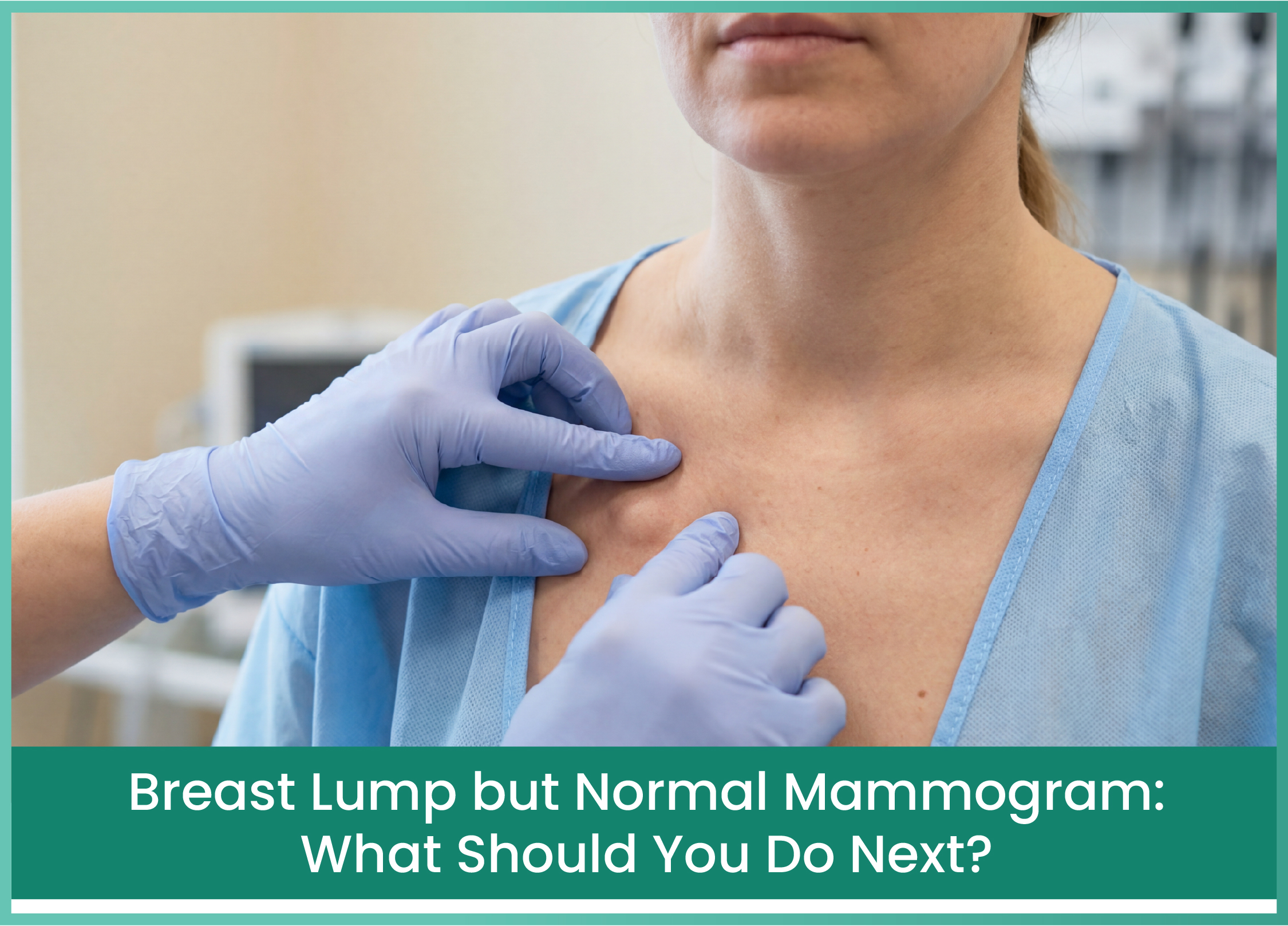
Finding a breast lump can be worrying, especially when you have already had a mammogram and the report says everything is normal. A common question many women ask is: “If my mammogram is normal, why can I still feel a lump in my breast?”
The important thing to understand is that a normal mammogram does not always mean that a palpable breast lump should be ignored. Most breast lumps are benign, meaning they are not cancerous. However, a new, persistent or changing lump still deserves appropriate clinical evaluation.
A mammogram is an important breast imaging test, but it is only one part of evaluation a breast lump. Depending on your age, breast density, the characteristics of the lump and your clinical examination, your doctor may recommend a breast ultrasound, diagnostic mammogram, follow-up examination, or sometime a biopsy.
If you are in Mumbai and have a persistent breast lump despite a normal mammogram, consulting an experienced breast or cancer specialist can help determine what should happen next. For patients looking for breast cancer treatment in Mumbai, breast cancer treatment in Tardeo, or a cancer doctor in south Mumbai, an individual assessment is more important than relying on a normal screening report alone.
Can You Have a Breast Lump Even When the Mammogram Is Normal?
Yes.
A mammogram can be normal even when a woman can clearly feel a lump. This does not automatically mean the lump is cancerous, but it also does not mean the lump should automatically be dismissed.
Mammography uses X-rays to create images of breast tissue. Its ability to detect abnormalities can be affected by several factors, including the density and composition of breast tissue and the location or characteristics of the abnormality.
The American College of Radiology notes that imaging evaluation is necessary to appropriately characterize a palpable breast mass and that the imaging findings should correspond with the area identified during clinical examination. Importantly, a negative imaging evaluation should not automatically prevent further investigation when the physical examination remains strongly suspicious.
This is why the question should not simply be:
“Was my mammogram normal?”
Instead, the more important question is:
“Does the normal mammogram adequately explain the lump I can feel?”
That distinction can make a significant difference in deciding what to do next.
Why Can a Mammogram Miss a Breast Lump?
There are several possible reasons why a lump may not be obvious on a mammogram.
1. Dense breast tissue
Some women have dense breast tissue, which can
make abnormalities more difficult to see on mammographic images. Dense tissue contains more
glandular and connective tissue relative to fatty tissue.
When a woman has dense breasts and a palpable abnormality, her doctor may consider additional imaging such as targeted breast ultrasound.
2. The lump may have a benign cause
Not every breast lump is cancer.
Common benign causes include:
- Breast cysts
- Fibroadenomas
- Fibrocystic breast changes
- Lipomas
- Hormonal breast changes
- Inflammation or infection
- Changes associated with breastfeeding
- Other benign breast conditions
Ultrasound can be particularly useful because it can help determine whether a lump is fluid-filled or solid.
3. The abnormality may require targeted imaging
A screening mammogram is generally designed to look for breast abnormalities before symptoms develop. When you already have a specific lump or area of concern, your doctor may recommend diagnostic imaging focused on that area.
A diagnostic mammogram differs from a screening mammogram because the imaging is performed with the known clinical concern in mind.
4. The lump may need clinical correlation
Sometimes the most important information comes from putting the examination and imaging findings together.
If you can feel a distinct lump but imaging does not show an obvious abnormality, your doctor needs to determine whether the clinical finding and imaging result are actually concordant.
This is one reason why seeing a doctor experienced in evaluating breast symptoms is important.
What Should You Do If You Feel a Lump but Your Mammogram Is Normal?
The next step depends on your individual situation, but there is a practical approach.
Step 1: Do Not Panic
First, remember that most breast lumps are not cancerous.
A lump can occur for many reasons, and a normal mammogram is certainly reassuring. However, reassurance should come from appropriate evaluation rather than simply assuming that nothing needs to be done.
A new or persistent lump should be discussed with a healthcare professional, particularly if it feels different from the surrounding breast tissue or does not disappear.
Step 2: Get a Clinical Breast Examination
Your doctor may examine both breasts as well as the lymph nodes around the underarm and other relevant areas.
During the examination, the doctor may assess:
- Where the lump is located
- Its size
- Whether it feels soft or firm
- Whether it moves or appears fixed
- Whether it has changed over time
- Whether there are skin or nipple changes
- Whether there are enlarged lymph nodes
The physical examination cannot reliably determine whether a breast lump is benign or malignant by itself, but it provides important information for deciding what investigation may be appropriate.
Ask Whether a Targeted Breast Ultrasound Is Appropriate
If you have a palpable lump and the mammogram is normal, your doctor may recommend a targeted breast ultrasound.
An ultrasound uses sound waves rather than X-rays. It can help determine whether the area is:
- A fluid-filled cyst
- A solid mass
- Normal breast tissue
- A benign-appearing lesion
- An area requiring further assessment
Ultrasound is often an important complementary test when evaluating a palpable breast abnormality.
This is especially relevant for women with dense breast tissue or when the palpable abnormality is not adequately explained by mammography.
What If the Mammogram and Ultrasound Are Both Normal?
This is where clinical judgment becomes especially important.
If both mammography and ultrasound are reassuring and the doctor considers the physical examination low-risk, you may simply be advised to monitor the area or return for follow-up.
However, if the lump remains clinically suspicious despite negative imaging, further evaluation may still be necessary.
The American College of Radiology states that negative mammography and ultrasound have a high negative predictive value for palpable masses, but negative imaging should not deter biopsy when the physical examination is strongly suspicious.
In other words:
Normal imaging is reassuring, but the physical examination still matters.
Your doctor may recommend short-term follow-up, additional imaging in selected situations, referral to a breast specialist, or tissue sampling depending on the overall picture.
When Is a Breast Biopsy Needed?
A biopsy is a procedure in which a sample of tissue is removed and examined by a pathologist.
It may be recommended when imaging identifies a suspicious abnormality or when the clinical findings remain concerning despite inconclusive imaging.
Depending on the situation, different types of biopsy may be considered, including:
- Core needle biopsyt
- Ultrasound-guided biopsy
- Stereotactic biopsy
- Fine-needle aspiration in selected circumstances
- Surgical biopsy in particular cases
A core needle biopsy removes small tissue samples from the suspicious area for laboratory examination.
Importantly, having a biopsy does not mean that you have breast cancer. A biopsy is performed to find out what a suspicious or unexplained abnormality actually is.
Can a Normal Mammogram Completely Rule Out Breast Cancer?
No test should be interpreted in isolation.
A normal mammogram is reassuring, but no screening or diagnostic test detects every breast cancer.
This is why a persistent breast change should not be ignored simply because you had a recent normal mammogram.
Mayo Clinic recommends medical evaluation for a new or persistent breast lump and notes that even after a recent mammogram that appeared normal, new breast changes should still be assessed.
The goal is not to create unnecessary fear. The goal is to make sure that a genuine clinical concern has been appropriately evaluated.
Signs That Mean You Should See a Doctor Promptly
A breast lump deserves medical attention particularly when it is new, persistent or changing.
Seek medical evaluation if you notice:
- A new lump in the breast
- A lump that continues after your menstrual cycle
- A lump that becomes larger or firmer
- A firm or fixed lump
- Skin dimpling or puckering
- Changes resembling an orange-peel texture
- New nipple inversion
- Bloody or unusual nipple discharge
- A change in breast size or shape
- Persistent focal breast pain
- A new lump in the underarm
- Thickening or an area that feels distinctly different from the surrounding tissue
These symptoms do not necessarily mean breast cancer. Many benign conditions can produce similar changes. But they are reasons to have the breast examined rather than relying only on a previous mammogram.
Does Breast Pain Along With a Lump Mean Cancer?
Not necessarily.
Does Breast Pain Along With a Lump Mean Cancer?
Breast pain can occur with hormonal changes, cysts, inflammation and several benign breast conditions. Some breast cancers can also cause discomfort, although pain by itself is not a reliable way to distinguish cancer from a benign condition.
If pain is persistent, localized or accompanied by a new lump or other breast change, it is worth discussing with a doctor.
The important point is to evaluate the overall pattern of symptoms, rather than trying to determine the diagnosis based on pain alone.
What If the Lump Changes With Your Menstrual Cycle?
Hormonal changes can make breast tissue feel more swollen, tender or lumpy at certain points during the menstrual cycle.
Some benign breast changes may become more noticeable before a period and then settle afterward.
However, a lump that repeatedly persists, becomes more prominent, changes in character or feels distinctly different from the surrounding tissue should still be evaluated.
Do not assume that every lump that appears around your period is hormonal without discussing persistent or unusual changes with your doctor.
What If You Are Under 40?
The evaluation of a breast lump can vary according to age.
In younger women, breast ultrasound is often particularly useful because younger breast tissue can be denser. Depending on the clinical situation, age and findings, your doctor may recommend ultrasound, mammography or both.
The important principle is that there is no single breast imaging test that is appropriate for every woman with a lump.
Your doctor should choose investigations based on your symptoms, age, examination findings, risk factors and previous imaging.
What If You Are Over 40?
A new breast lump after 40 should be evaluated rather than attributed automatically to hormonal changes or aging.
Your doctor may recommend diagnostic mammography, ultrasound or additional assessment depending on your clinical findings.
If you have already undergone a screening mammogram and subsequently notice a new lump, tell your doctor specifically that you have a new palpable breast abnormality.
A screening examination and the evaluation of a new symptom are not necessarily the same clinical situation.
What about Breast MRI?
Breast MRI is not automatically the next test for every woman with a palpable lump and normal mammography.
MRI may be considered in selected situations when the diagnosis remains unclear, particularly when there are specific clinical concerns or other factors that justify additional imaging.
It should generally be used as part of an individualized evaluation rather than simply because a mammogram was normal.
Your breast specialist or radiologist can determine whether MRI adds useful information in your particular situation.
Why You Should Not Wait Too Long With a Persistent Lump?
One of the most common mistakes is assuming:
“My mammogram was normal, so I'll wait and see.”
Sometimes observation is appropriate—but it should be based on a doctor's assessment.
If the lump continues, grows, becomes harder, changes in appearance or is accompanied by nipple or skin changes, arrange another medical evaluation.
A persistent breast lump should be assessed even if you have already had reassuring imaging.
Early evaluation does not mean that you have cancer. It simply means that the cause of the lump is being properly established.
What Should You Take to Your Breast Specialist Appointment?
If you are seeing a doctor for a breast lump, take your previous breast-related medical records if available.
These may include:
- Previous mammogram reports
- Mammogram images or digital records
- Breast ultrasound reports
- Previous biopsy reports
- Pathology reports
- Previous breast MRI reports
- Details of previous breast surgery
- Information about family history of breast or ovarian cancer
- A list of current medications and hormonal treatments
Also make a note of when you first noticed the lump and whether it has changed in size or sensation.
This information can help your doctor understand the complete clinical picture.
Why Choosing the Right Breast Cancer Specialist Matters?
When a woman has a palpable breast lump despite normal imaging, the objective is not simply to order more tests.
The objective is to answer three important questions:
What is the lump?
Does the imaging explain what can be felt clinically?
Does the patient need monitoring, additional investigation or tissue diagnosis?
An experienced breast and cancer specialist can help connect the clinical examination, imaging and pathology when required.
For women looking for a breast cancer specialist in Mumbai, cancer doctor in South Mumbai, or Best cancer specialist in Tardeo, Dr Reetu Jain can be considered as a specialist to discuss breast-related cancer concerns and appropriate next steps.
Patients seeking information about breast cancer treatment in Tardeo or breast cancer treatment in Mumbai should remember that treatment is not determined by a lump alone. If cancer is diagnosed, treatment depends on factors such as the type and stage of cancer, receptor status, overall health and individual patient circumstances.
Breast Lump but Normal Mammogram: What Should You Do Next?
If you can feel a breast lump but your mammogram is normal, don't panic—but don't ignore the lump either.
A sensible next step is:
- Get the lump clinically examined.
- Discuss whether targeted breast ultrasound is appropriate.
- Make sure the imaging findings correspond to the area you can actually feel.
- Follow the recommended monitoring plan if the findings are reassuring.
- If the lump remains suspicious or unexplained, ask whether further investigation or biopsy is needed.
The American College of Radiology emphasizes the importance of correlating the palpable finding with imaging and notes that a strongly suspicious clinical finding may still require biopsy despite negative imaging.
A normal mammogram is good news but it is not a reason to ignore a breast lump that you can still feel.
Most breast lumps are benign, but every persistent or unusual lump deserves the right evaluation. A clinical breast examination, targeted ultrasound and, when appropriate, biopsy can help determine what is actually causing the lump.
If you have noticed a new or persistent breast lump and are unsure what to do after a normal mammogram, consider discussing your symptoms and reports with Dr Reetu Jain or another qualified breast/cancer specialist.
For patients in Mumbai looking for a cancer doctor in South Mumbai, breast cancer specialist in Mumbai, breast cancer treatment in Mumbai, breast cancer treatment in Tardeo, or a cancer specialist in Tardeo, timely consultation can help you understand your findings and decide on the appropriate next step.
Don't let a normal mammogram be the end of the conversation if you can still feel a persistent change. The right evaluation can provide clarity and, when necessary, help ensure that treatment begins at the right time.